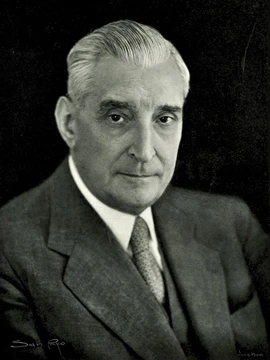
William James Sidis
Child prodigy who later retreated from public life.
William James Sidis (April 1, 1898 – July 17, 1944) was an American child prodigy with exceptional skills in mathematics and language. He worked as a mathematician, linguist, historian, and author. In 1925, he published *The Animate and the Inanimate*, a book speculating about life’s origins within thermodynamics. He never used his real name on his writings, instead publishing under various pseudonyms.
His father, psychologist Boris Sidis, raised him with specific methods aimed at producing a gifted child. Sidis first became famous for his early brilliance, then later for his eccentricity and retreat from public life. He eventually stopped working in mathematics altogether, writing on other topics under fake names. He entered Harvard University at age 11. As an adult, family members claimed his IQ fell between 250 and 300 and that he knew about 25 languages and dialects. These claims were never verified, but contemporaries like Norbert Wiener and Daniel Frost Comstock agreed he was extremely intelligent. After being arrested and tried for attending a socialist parade, he withdrew from public view and died young from a brain hemorrhage.
**Biography**
**Parents and Upbringing (1898–1908)** Sidis was born on April 1, 1898, in Boston, Massachusetts, to Jewish emigrants from the Russian Empire (now Ukraine). His father, Boris Sidis, fled political and antisemitic persecution in 1887. His mother, Sarah (Mandelbaum) Sidis, and her family escaped pogroms in the late 1880s. She attended Boston University and graduated from its medical school in 1897. William was named after his godfather, philosopher William James, a friend and colleague of Boris. Boris was a psychiatrist who published many books and articles on abnormal psychology and was also a polyglot. Sidis’s parents believed in fostering a fearless love of knowledge, though their parenting was criticized in the media and later. Sidis could read the *New York Times* at 18 months. By age eight, he had reportedly taught himself eight languages—Latin, Greek, French, Russian, German, Hebrew, Turkish, and Armenian—and invented another, which he called “Vendergood.”
**Harvard University (1909–1914)** Harvard had previously refused to enroll Sidis at age nine because he was still a child, but in 1909, at age 11, he set a record as the youngest person ever admitted. In early 1910, his mastery of higher mathematics l
- born
- April 1, 1898, Boston, Massachusetts
- died
- July 17, 1944, Boston, Massachusetts
- field
- Mathematics, linguistics, history, writing
- nationality
- American
- known_for
- Child prodigy; youngest Harvard enrollee at age 11; speculated about origin of life in thermodynamics in The Animate and the Inanimate
Lore & Background
In 1919, Sidis was arrested for participating in a socialist May Day parade that turned violent, and was sentenced to 18 months under the Sedition Act. His parents held him in their sanatorium for a year and then took him to California. After returning to the East Coast in 1921, he lived a private life, working menial jobs and collecting streetcar transfers. He wrote under pseudonyms, including The Animate and the Inanimate (1925) and an unpublished manuscript, The Tribes and the States. He sued The New Yorker over a 1937 article that described his life as lonely, settling for $3,000. He died of a cerebral hemorrhage at age 46.
Reader's Guide
William James Sidis remains a notable figure in the study of child prodigies and the pressures of early fame. His intellectual achievements—entering Harvard at 11, lecturing on advanced mathematics, and reportedly mastering many languages—were widely reported, though claims of his IQ and language count remain unverified. His retreat from public life after his arrest and his subsequent avoidance of mathematics highlight the personal costs of his upbringing and notoriety. His speculative work on thermodynamics and the origin of life, as well as his writings on Native American history and streetcar transfers, show a broad but scattered intellectual curiosity. The legal case over his privacy, which he ultimately lost, became a landmark in discussions of public figures and press freedoms. Sidis's life is often cited as a cautionary tale about the exploitation of gifted children and the difficulty of living under intense public scrutiny.
Did You Know?
- Sidis could read the New York Times at 18 months.
- He invented a language called Vendergood by age eight.
- He was arrested for participating in a socialist May Day parade in 1919.
- He wrote a treatise on streetcar transfers titled Notes on the Collection of Transfers.
More in part-1
Spotted an error? Know more?
This is a living reference — every entry is fact-audited, and reader corrections feed straight into our audit queue. Suggest an edit · See this site's audit record